
Textiles, home furnishings, automobile interiors, nonwovens, and industrial items all make extensive use of polyester staple fiber (PSF). The two main types—solid and hollow PSF—differ in internal structure, which affects weight, insulation, resilience, cost, and performance.
Selecting between them depends on product needs, performance goals, and budget.
Understanding the Structural Difference
The most fundamental distinction lies in the fiber’s cross-section.
Solid Polyester Staple Fiber
Solid PSF has a fully dense internal structure. The fiber cross-section is completely filled with polyester polymer, offering consistent density and mechanical strength throughout.
Hollow Polyester Staple Fiber
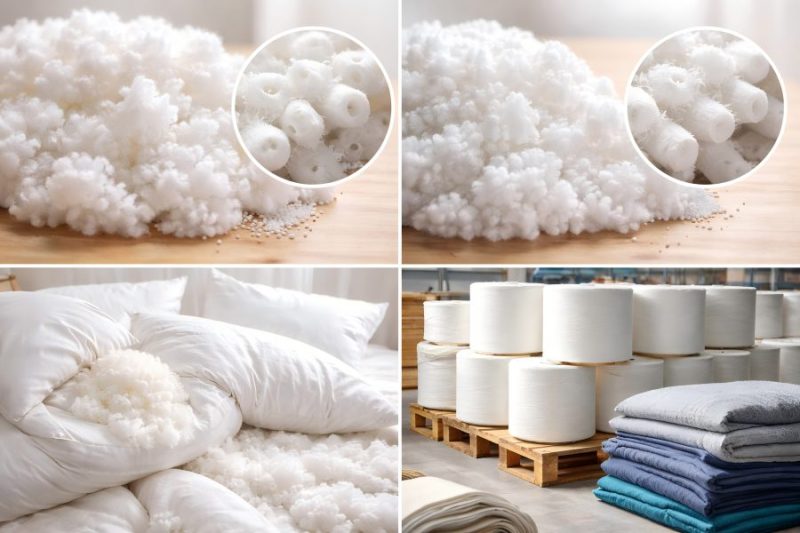
Hollow PSF contains one or more air channels running through its core. These void spaces reduce weight and enhance insulation. Hollow fibers may be:
- Single-hole
- Multi-hole (4-hole, 7-hole, etc.)
- Siliconized (for added softness)
This structural variation dramatically affects performance characteristics.
Physical and Mechanical Property Comparison
| Property | Solid PSF | Hollow PSF |
| Density | Higher | Lower |
| Weight per Volume | Heavier | Lighter |
| Thermal Insulation | Moderate | Excellent |
| Resilience / Loft | Good | Very High |
| Compression Recovery | Moderate | Superior |
| Tensile Strength | Higher | Slightly Lower |
| Cost | Generally Lower | Slightly Higher |
| Primary Applications | Textiles, yarn spinning | Filling, insulation |
Performance Differences
Weight and Density
Because hollow PSF contains internal air pockets, it is significantly lighter than solid PSF at the same denier and cut length. This makes hollow fiber ideal for applications requiring volume without weight — such as pillow filling or winter jackets.
Solid PSF, being fully dense, adds more structural mass and is often preferred where weight is less of a concern.
Thermal Insulation
Hollow PSF excels in insulation performance. The trapped air inside the fiber core reduces heat transfer, creating a thermal barrier similar to down feathers.
This makes hollow PSF particularly suitable for:
- Quilts
- Comforters
- Sleeping bags
- Insulated garments
Solid PSF provides moderate insulation but lacks the enhanced air-trapping capability of hollow fibers.
Resilience and Loft
Loft refers to the fiber’s ability to create bulk and maintain volume. Hollow fibers provide superior loft due to internal air cavities and often enhanced crimping structures.
In comparison:
- Solid PSF offers stable structure but less fluffiness.
- Hollow PSF maintains softness and volume even after compression.
Compression Recovery
The capacity of hollow PSF to recover from compression is one of its greatest benefits. For example, in pillows or cushions, hollow fibers recover shape faster than solid fibers.
This resilience improves:
- Product lifespan
- Comfort consistency
- User experience
- Solid PSF may flatten over time under repeated pressure.
Strength and Durability
Solid PSF generally offers slightly higher tensile strength due to its fully dense structure. This extra strength can be useful for creating woven textiles or spinning yarn.
Hollow PSF, while strong enough for filling applications, may not match solid fiber’s performance in high-tension textile processing.
Cost Comparison
Cost differences between hollow and solid PSF are typically moderate but important in bulk production.
Why Hollow PSF Costs More
More complex spinneret design during extrusion
- Additional processing controls
- Often siliconized for softness
Typical Market Position
| Fiber Type | Relative Price Level |
| Solid PSF | Lower |
| Hollow PSF | Medium |
| Siliconized Hollow PSF | Higher |
However, because hollow PSF is lighter per unit volume, manufacturers sometimes use less weight to achieve the same filling effect — partially offsetting higher per-kilogram cost.
Application Comparison
Solid Polyester Staple Fiber Applications
Solid PSF is commonly used in:
- Yarn spinning
- Blended textiles
- Non-woven fabrics
- Automotive upholstery
- Carpets
- Industrial felts
Its strength and dimensional stability make it suitable for structural textile products.
Hollow Polyester Staple Fiber Applications
Hollow PSF dominates in:
- Pillow and cushion filling
- Quilts and comforters
- Winter jackets
- Stuffed toys
- Sleeping bags
- Acoustic insulation panels
Its lightweight and thermal efficiency properties are unmatched in soft filling uses.
Environmental and Sustainability Considerations
Both hollow and solid PSF can be produced using:
- Virgin PET
- Recycled PET (rPET from bottles)
- GRS-certified recycled content
From a sustainability perspective:
- Hollow PSF may require slightly more processing energy.
- Both types contribute similarly to microplastic shedding unless treated.
- Recycled PSF is widely available in both solid and hollow forms.
Siliconized vs Non-Siliconized Fibers
Many hollow fibers are treated with silicone oil for enhanced softness and smoothness. This improves:
- Hand feel
- Anti-clumping behavior
- Fiber separation
Solid fibers are less commonly siliconized because they are more frequently used in structural textiles rather than comfort applications.
Pros and Cons Summary
Solid Polyester Staple Fiber
Advantages
- Lower cost
- Higher tensile strength
- Ideal for yarn spinning
- Durable in structural applications
Disadvantages
- Heavier
- Lower insulation
- Less loft and rebound
Hollow Polyester Staple Fiber
Advantages
- Lightweight
- Excellent thermal insulation
- Superior loft and softness
- Better compression recovery
Disadvantages
- Slightly higher cost
- Slightly lower tensile strength
- Not ideal for high-tension textile spinning
Decision Guide: Which Should You Choose?
Choose Solid PSF If:
- You are producing yarn or woven textiles.
- Structural integrity is critical.
- Budget sensitivity is high.
The product does not require thermal insulation.
Choose Hollow PSF If:
You manufacture bedding or cushioning products.
- Thermal insulation is required.
- Lightweight filling is important.
- Softness and comfort are top priorities.
Hybrid and Blended Solutions
In some cases, manufacturers blend hollow and solid fibers to balance cost and performance. For example:
- 70% hollow + 30% solid for better cost-performance ratio
- Blending hollow PSF with microfiber for enhanced softness
- Such combinations can deliver optimized loft, durability, and budget control.
Future Market Trends
The global PSF market continues to grow, driven by:
- Increased demand for home textiles
- Sustainable recycled fiber production
- Growth in automotive interiors
- Rising insulation material needs
Hollow PSF demand is increasing in premium bedding and outdoor apparel markets, while solid PSF remains dominant in mass textile production.
Final Comparison Table
| Selection Factor | Best Choice |
| Budget-sensitive textile production | Solid PSF |
| High-loft bedding | Hollow PSF |
| Winter clothing insulation | Hollow PSF |
| Yarn spinning | Solid PSF |
| Automotive non-woven materials | Solid PSF |
| Premium pillow filling | Hollow PSF |
The choice between hollow and solid polyester staple fiber ultimately depends on the balance between cost, insulation needs, strength requirements, and product purpose.
- Solid PSF delivers strength, cost efficiency, and structural reliability for textiles and industrial uses.
- Hollow PSF excels in comfort, insulation, and lightweight filling applications.
- Blended solutions might be the most sensible option for firms looking to maximize both performance and cost.
Understanding the structural differences and performance implications allows you to select the right fiber type — ensuring your final product meets market expectations while maintaining production efficiency.