
Industrial wipes are an essential tool in manufacturing, automotive, medical, food processing, aerospace, and many other sectors where cleanliness, contamination control, and operational efficiency are crucial. Among the wide range of materials used to manufacture industrial wipes, Polyester Staple Fiber (PSF) has emerged as the preferred choice for high-performance applications. Selecting the right material for industrial wipes directly impacts durability, absorbency, cost effectiveness, and overall efficacy.
What Is Polyester Staple Fiber
Polyethylene terephthalate (PET) is the source of polyester staple fiber, a synthetic fiber. PSF fibers are later processed into nonwoven fabrics or blends suitable for industrial wipes.
Key characteristics include:
- High strength and tear resistance
- Structural stability
- Resistance to chemicals and solvents
- Low moisture retention
- Thermal resilience
Because of these attributes, polyester staple fiber forms the backbone of many premium industrial wipe products.
Why Material Matters in Industrial Wipes
Industrial wipes are used for cleaning, degreasing, sanitizing, applying and removing solvents, and wiping contaminants from surfaces. In harsh environments, weak or inappropriate materials can:
- Lint or shed fibers onto surfaces
- Break apart easily
- Absorb too slowly or hold contaminants
- Chemical degradation or shrinkage
The right material must balance absorbency, strength, chemical resistance, and cost.
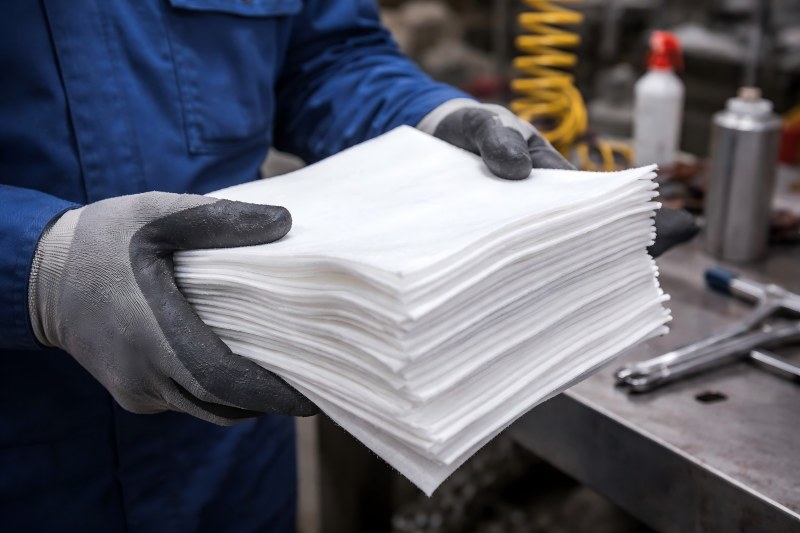
Advantages of Polyester Staple Fiber for Industrial Wipes
High Tensile Strength and Durability
Polyester fibers retain strength even when wet—unlike cotton or viscose—which means wipes remain intact during heavy scrubbing and long service times.
Tensile Strength Comparison of Common Wipe Materials
| Material | Dry Tensile Strength | Wet Tensile Strength | Relative Durability |
| Polyester Staple Fiber | High (100%) | High (90–95%) | Excellent |
| Cotton | Moderate (80%) | Low (30–40%) | Poor–Fair |
| Viscose Rayon | Low (60%) | Very Low (20–25%) | Poor |
| Polypropylene | Moderate (85%) | Moderate (70%) | Fair–Good |
Data representative; relative percentages for comparative purposes.
PSF’s ability to maintain strength in both dry and wet states makes it ideal for industrial settings where wipes encounter liquids, oils, and solvents.
Chemical and Solvent Resistance
Industrial environments often require wipes to interact with harsh chemicals like degreasers, alcohols, and acids. Polyester’s chemical makeup delivers excellent resistance, preventing fiber degradation.
Typical chemical resistance benefits include:
- Minimal swelling or weakening
- No chemical bonding with residues
- Compatibility with most industrial solvents
This makes PSF wipes especially suitable for automotive, aerospace, and metalworking sectors.
Controlled Absorbency and Release
Although polyester is hydrophobic (water-repelling) by nature, engineered PSF wipes can be designed to balance liquid handling via:
- Fiber blending (e.g., with hydrophilic fibers)
- Mechanical entanglement in nonwoven structures
- Surface treatments
Absorbency Profiles of Industrial Wipe Materials
| Material | Water Absorbency | Oil Absorbency | Typical Use Case |
| Polyester Staple Fiber | Moderate (5–8 g/g) | High (7–10 g/g) | General cleanup, solvents |
| Cotton | High (12–15 g/g) | Moderate (5–7 g/g) | Heavy liquid spills |
| Viscose Rayon | High (10–13 g/g) | Moderate (5–7 g/g) | Surface finishing |
| Polypropylene | Low–Moderate (4–6 g/g) | High (8–12 g/g) | Oil absorption tasks |
Approximate values; actual performance depends on nonwoven structure and production processes.
While cotton has greater water absorbency, PSF excels in oil and solvent pickup and offers a balanced profile ideal for industrial fluids.
Low Linting and Cleanroom-Ready Options
In settings where contamination management is crucial, high-performance wipes are frequently utilized. Polyester’s smooth and strong fibers produce low linting when manufactured into nonwovens with appropriate bonding techniques.
This is particularly important for:
- Electronics manufacturing
- Cleanrooms and labs
- Aerospace components
- Precision optics
Wipes made with PSF meet stringent standards for particle and fiber release.
Thermal Stability and Reusability
Polyester can withstand higher temperatures than many natural fibers. This thermal stability allows PSF wipes to be:
- Autoclaved for sterilization
- Reused in controlled environments
- Used in heat-exposed applications
PSF wipes can often be washed and reused multiple times, reducing long-term costs.
Industrial Applications of PSF Wipes
Polyester staple fiber wipes are widely used in many sectors. Below is a breakdown of primary use cases:
A. Manufacturing & Maintenance
- Equipment degreasing
- Surface preparation
- Oil and coolant removal
- Daily cleaning and upkeep
B. Food Processing and Sanitation
- Cleaning conveyor belts
- Sanitizing equipment
- Spill containment
Note: Food use may require FDA compliant finishes.
C. Automotive Industry
- Detailing and polishing
- Wiping brake cleaners and degreasers
- Engine bay cleanup
D. Electronics & Precision Manufacturing
- Cleanroom wipe tasks
- Dust and particle removal
- Optical surface cleaning
E. Medical and Laboratory Environments
- Instrument cleaning
- Spill control in labs
- Sterile procedures (with suitable processing)
Performance Comparison: PSF vs Other Technologies
Industrial wipes can be made with a variety of technologies: woven, knitted, nonwoven, and blends. Polyester staple fiber is most often used in nonwoven formats due to its versatility.
Material & Production Technology Comparison
| Feature | PSF Nonwoven | Cotton Woven | Blended (PSF + Cellulosic) | PP Meltblown |
| Strength (wet/dry) | ⭐⭐⭐⭐ | ⭐⭐ | ⭐⭐⭐ | ⭐⭐⭐ |
| Chemical resistance | ⭐⭐⭐⭐ | ⭐⭐ | ⭐⭐⭐ | ⭐⭐⭐⭐ |
| Linting behavior | ⭐⭐⭐⭐ | ⭐⭐ | ⭐⭐⭐ | ⭐⭐⭐ |
| Surface trapping (particles) | ⭐⭐⭐⭐ | ⭐⭐ | ⭐⭐⭐ | ⭐⭐⭐⭐ |
| Cost per wipe | ⭐⭐⭐ | ⭐⭐⭐ | ⭐⭐⭐ | ⭐⭐ |
| Reusability | ⭐⭐⭐⭐ | ⭐⭐ | ⭐⭐⭐ | ⭐⭐ |
| Absorbency control | ⭐⭐⭐ | ⭐⭐⭐⭐ | ⭐⭐⭐⭐ | ⭐⭐ |
Rating scale: ⭐ = low, ⭐⭐⭐⭐ = excellent.
PSF nonwovens balance strength, low linting, and chemical resistance. Cotton offers absorbency but lacks durability and chemical tolerance.
Cost and Sustainability Considerations
Economic Value
While cotton and polypropylene wipes may have lower upfront costs, PSF wipes often provide better value over time due to:
- Longer service life
- Lower replacement frequency
- Reduced contamination risk
- Enhanced performance with aggressive cleaning tasks
Reusability and Lifecycle Impact
Polyester’s durability supports repeated use, which lowers waste generation and can reduce total cost per use. Some customers wash and reuse PSF wipes — especially in maintenance and fabrication shops — extending longevity.
Recycling Opportunities
PET polyester can be recycled. Some manufacturers integrate recycled polyester staple fiber into their wipe products, supporting circular economy initiatives.
Choosing the Right PSF Wipe for Your Needs
When selecting polyester staple fiber wipes, consider:
| Criteria | Importance |
| Wipe weight (gsm) | Determines strength and absorbency |
| Nonwoven process | Spunlace, needle punch, and hydroentanglement affect performance |
| Particle emission standards | For cleanroom use |
| Chemical compatibility | Based on fluids users handle |
| Cost per wipe vs lifecycle cost | Total cost of ownership |
| Reusability | Washability and durability |
Consult suppliers to obtain performance datasheets and conduct tests with your specific industrial fluids or cleaning tasks.
Case Studies: PSF Wipes in Action
Automotive Manufacturing
An automotive assembly line replaced cotton wipes with PSF hydroentangled wipes. Results:
- Decreased wipe tear-offs by 68%
- Reduced downtime for cleaning
- Improved removal of oils and greases
Cleanroom Assembly
A semiconductor facility upgraded to low-lint PSF wipes. Outcomes:
- Particle counts in critical zones have been reduced
- Yield increased on precision sensor production
- Cleanroom contamination events declined
Machine Shop Maintenance
A metal fabrication shop began using reusable PSF wipes for tool cleaning. Results:
- Wipe consumption dropped by 40%
- Annual material spend has been reduced
- Solvent waste decreased
Future Trends in PSF Industrial Wipes
Enhanced Functional Finishes
Future PSF wipes may include:
- Antistatic treatments
- Antimicrobial coatings
- Enhanced wetting finishes
Sustainable Blends and Recycling
More manufacturers will prioritize recycled PSF content and design end of life recycling programs.
Smart Materials
Research into responsive and sensor integrated wipe fabrics could support traceable contamination control in advanced manufacturing.
Polyester staple fiber has become the material of choice for high performance industrial wipes due to its superior strength, chemical resilience, controlled absorbency, low linting behavior, and economic value over time. While alternatives like cotton and polypropylene remain useful in specific settings, PSF wipes deliver a balanced profile that meets the demanding needs of modern industrial environments.
Whether you manufacture wipes, specify them for your facility, or compare materials for performance, understanding polyester staple fiber’s unique advantages ensures a more effective and reliable cleaning solution.