
Polyester Staple Fiber, or PSF, is widely used in textiles, nonwovens, filling, filtration, geotextiles, hygiene products, and automotive interiors.
For buyers, PSF quality affects production efficiency, product appearance, softness, strength, and durability. Hidden issues like uneven length, poor crimp, excess oil, high moisture, or contamination can cause mass production problems.
Sample testing helps buyers check quality through appearance, lab data, and production trials before placing bulk orders.
Why PSF Sample Testing Matters
Polyester Staple Fiber is usually purchased in large quantities. Once the wrong material enters the production line, it may lead to yarn defects, fabric quality problems, nonwoven web unevenness, poor filling resilience, machine downtime, and material waste.
Sample testing helps buyers:
- Confirm whether the fiber matches the required specification
- Compare quality differences between suppliers
- Check whether the fiber is suitable for the final application
- Reduce the risk of poor bulk order quality
- Avoid production problems before mass purchasing
- Verify the supplier’s technical claims
- Support price negotiation with real quality data
- Build a reliable supplier evaluation system
For international buyers, sample testing is especially important because communication, transportation time, and quality disputes can increase purchasing risks.
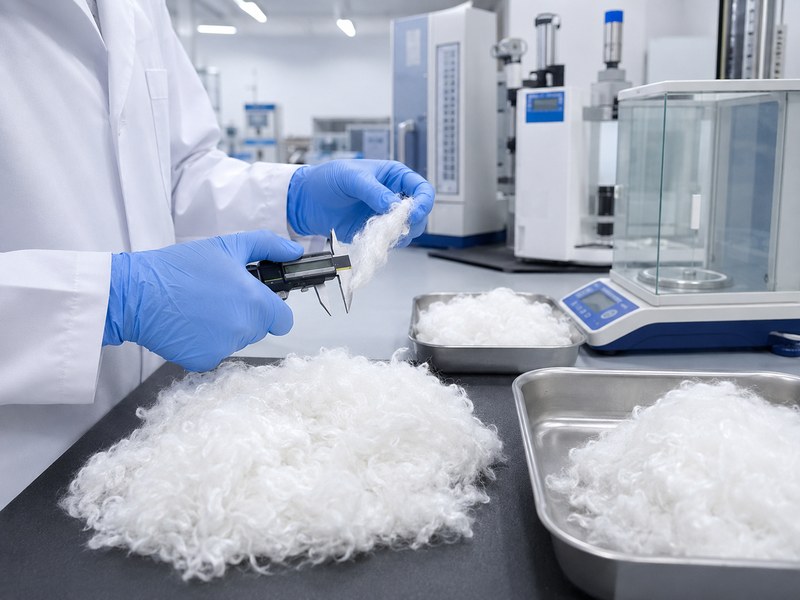
Basic Polyester Staple Fiber Specifications
Before testing a PSF sample, buyers should clearly define the required specifications. Different applications need different fiber properties.
| Specification | Common Options | Why It Matters |
| Fiber Denier | 0.7D, 1.4D, 1.5D, 3D, 6D, 7D, 15D | Affects softness, thickness, and application |
| Cut Length | 32 mm, 38 mm, 51 mm, 64 mm | Affects spinning, carding, and web formation |
| Fiber Type | Solid, hollow, conjugated, siliconized, recycled, virgin | Determines performance and end use |
| Color | Raw white, optical white, black, dope dyed | Affects final product appearance |
| Tenacity | Low, medium, high strength | Affects yarn, fabric, and product durability |
| Elongation | Depends on grade | Affects flexibility and processing stability |
| Crimp | Normal crimp, 2D crimp, 3D crimp | Affects bulkiness and fiber cohesion |
| Oil Content | Controlled finish level | Affects carding, static, and smoothness |
| Moisture Content | Usually low | Affects weight, storage, and quality stability |
| Impurity Level | Low to strict control | Affects product cleanliness and appearance |
Buyers should ask the supplier to provide a Technical Data Sheet, Certificate of Analysis, and sample batch information.
Step 1: Check Sample Packaging and Label
The first inspection starts before opening the package. Professional sample packaging shows that the supplier has basic quality management.
A complete PSF sample label should include:
- Supplier name
- Product name
- Fiber denier
- Cut length
- Fiber type
- Color
- Batch number
- Production date
- Sample weight
- Contact information
- Storage instructions
If the sample has no label or batch number, it may be difficult to trace quality problems later. Buyers should avoid approving samples that cannot be linked to a clear production batch.
The sample should also be sealed properly to avoid dust, moisture, and contamination during transportation.
Step 2: Visual Inspection
Visual inspection is a simple but useful first step. Spread the fiber on a clean white surface under bright light and check its overall appearance.
Main points to check:
- Is the color uniform?
- Are there black spots or colored fibers?
- Is there visible dust or powder?
- Are there hard lumps or unopened fiber clusters?
- Does the fiber look clean and bright?
- Is there yellowing or discoloration?
- Is the fiber too compressed?
- Does the fiber have an abnormal smell?
| Visual Problem | Possible Cause | Potential Risk |
| Yellowish color | Poor raw material or heat damage | Poor appearance, lower product grade |
| Black spots | Contamination during production | Defects in yarn, fabric, or nonwoven products |
| Fiber lumps | Poor opening or poor baling | Feeding and carding problems |
| Uneven color | Poor blending or dyeing control | Inconsistent final product |
| Excessive dust | Poor recycled material cleaning | Machine pollution and quality issues |
| Oil stains | Excessive or uneven finish | Staining and processing problems |
For white PSF, buyers can compare the sample with an approved standard sample. For black or dope-dyed PSF, color consistency should be checked carefully.
Step 3: Fiber Denier Testing
Denier refers to fiber fineness. It refers to the weight of 9,000 meters of fibre in grams.
Common denier applications:
| Application | Common Denier | Requirement |
| Yarn spinning | 1.2D–1.5D | Fine and uniform fiber |
| Nonwoven fabric | 1.5D–6D | Stable web formation |
| Pillow filling | 7D–15D | Good bulkiness and resilience |
| Wadding | 3D–15D | Softness and loft |
| Geotextile | 6D–15D+ | Strength and durability |
| Filtration media | 1.5D–6D | Clean and even fiber |
If the denier is not accurate, the final product may feel different, weigh differently, or perform poorly. For example, fiber that is too coarse may reduce softness, while fiber that is too fine may affect processing strength.
Buyers can ask a professional textile laboratory to test denier accuracy, especially for large orders or strict technical applications.
Step 4: Cut Length Measurement
Cut length is another key quality parameter. Polyester Staple Fiber is cut into specific lengths to match different processing methods.
Common PSF cut lengths include:
- 32 mm: cotton-type spinning
- 38 mm: spinning and textile blending
- 51 mm: nonwoven and wool-type applications
- 64 mm: filling, padding, and industrial use
To check cut length, buyers can randomly take fibers from different parts of the sample, straighten them gently, and measure them with a ruler or fiber length tester.
Important points:
- The average length should match the specification.
- Length variation should be controlled.
- There should not be too many short fibers.
- There should not be too many overlength fibers.
Uneven fiber length may cause poor carding, uneven web formation, high waste rate, yarn defects, and production instability.
Step 5: Tenacity and Elongation Testing
Tenacity means fiber strength. Elongation means how much the fiber can stretch before breaking. These two properties are important for spinning, textile, nonwoven, and industrial applications.
| Test Item | Meaning | Why Buyers Should Check It |
| Tenacity | Fiber breaking strength | Affects yarn, fabric, and product strength |
| Elongation | Stretch before breaking | Affects flexibility and processing stability |
| Strength variation | Stability between fibers | Affects production consistency |
If tenacity is too low, fibers may break during processing. If elongation is not suitable, the final product may lose flexibility or durability.
For spinning applications, stable tenacity is very important because weak fibers may increase yarn breakage and defects. For filling applications, resilience and softness may be more important than high tenacity.
Buyers should request laboratory test reports if the application requires strict mechanical performance.
Step 6: Crimp and Bulkiness Evaluation
Crimp refers to the wave-like shape of the fiber. It helps fibers hold together and improves bulkiness, elasticity, and hand feeling. Crimp is especially important for hollow conjugated fiber, filling fiber, wadding, and nonwoven applications.
Good crimp can improve:
- Fiber cohesion
- Carding performance
- Loft and volume
- Elastic recovery
- Softness
- Warmth retention
- Web uniformity
| Crimp Quality | Appearance | Performance Result |
| Good crimp | Even wave shape | Better loft and resilience |
| Weak crimp | Almost straight fiber | Poor bulkiness |
| Uneven crimp | Mixed wave patterns | Unstable processing |
| Over-crimped fiber | Too curly or tangled | Difficult opening and feeding |
A simple test is to compress the fiber by hand and observe how quickly it returns to its original volume. Bulk recovery is one of the most crucial performance metrics for pillow, quilt, and cushion filling.
Step 7: Moisture Content Testing
Although polyester has low moisture absorption, moisture content still matters in purchasing. High moisture may increase actual weight, affect storage, and create quality concerns.
Buyers should check:
- Whether the package feels damp
- Whether there is condensation inside the bag
- Whether the fiber has an abnormal smell
- Whether the sample weight seems unusual
- Whether the supplier stores products properly
For accurate testing, the sample can be weighed, dried under controlled conditions, and weighed again to calculate moisture content.
High moisture may indicate poor storage conditions or poor packaging. In some cases, it may also affect commercial weight calculation.
Step 8: Oil Content and Hand Feeling
Polyester Staple Fiber usually contains a certain amount of spin finish or oiling agent. This finish helps reduce friction, control static electricity, and improve processing performance.
However, both excessive oil and insufficient oil can cause problems.
| Oil Content Issue | Possible Problem |
| Too much oil | Sticky fiber, stains, dust attraction |
| Too little oil | Static electricity, poor carding, fiber damage |
| Uneven oiling | Unstable production performance |
| Poor-quality oil | Odor, yellowing, or processing issues |
A simple hand-feel test can provide an initial judgment. The fiber should feel smooth and soft, but not greasy. If obvious oil remains on the hand, further testing is recommended.
For spinning and nonwoven production, oil content should be stable because it directly affects feeding, carding, web formation, and machine cleanliness.
Step 9: Impurity and Contamination Check
Contamination is one of the most common problems in Polyester Staple Fiber, especially in recycled PSF. Buyers should carefully inspect impurities before confirming an order.
Common impurities include:
- Black particles
- Colored fibers
- Plastic chips
- Hard flakes
- Dust
- Metal particles
- Oil stains
- Undrawn fibers
- Foreign fibers
Inspection method:
- Spread the fiber on a clean white board.
- Separate the fiber layer by layer.
- Check under bright light.
- Count visible impurities.
- Compare the result with the supplier’s quality standard.
For white textiles, hygiene products, and high-end nonwovens, impurity control is very strict. Even small black spots may become visible defects in the final product.
Step 10: Application-Based Sample Testing
Different applications require different testing priorities. Buyers should not use the same standard for all PSF products.
| Application | Key Testing Focus |
| Yarn spinning | Denier, cut length, tenacity, elongation, low defects |
| Nonwoven fabric | Fiber opening, crimp, oil content, web uniformity |
| Pillow and quilt filling | Softness, bulkiness, hollow structure, resilience |
| Automotive interior | Strength, heat resistance, color stability |
| Geotextile | Coarse denier, tensile strength, durability |
| Filtration media | Fiber uniformity, cleanliness, thermal performance |
| Hygiene products | Softness, cleanliness, low contamination |
| Furniture padding | Loft, resilience, stability, cost performance |
For example, buyers purchasing PSF for pillow filling should focus on hollow structure, softness, crimp, and rebound performance. Buyers purchasing PSF for spinning should focus more on fiber length, fineness, tenacity, and defect rate.
Step 11: Small Production Trial
Laboratory testing is important, but production trial testing is more practical. Before placing a bulk order, buyers should test the PSF sample on actual production equipment.
During the trial, observe:
- Feeding stability
- Fiber opening performance
- Carding quality
- Static electricity
- Fiber breakage
- Web uniformity
- Yarn evenness
- Machine speed
- Waste rate
- Final product appearance
- Operator feedback
A sample may pass laboratory testing but still perform poorly in real production. Therefore, a small production trial is one of the most reliable ways to evaluate PSF quality.
Step 12: Compare Approved Sample with Bulk Order
One major risk in purchasing is that the approved sample is good, but the bulk shipment is different. Buyers should keep a sealed approved sample as a reference.
Before shipment, buyers can request:
- Pre-shipment sample
- Batch test report
- Production photos
- Packing list
- Certificate of Analysis
- Third-party inspection report
After receiving the bulk order, buyers should compare it with the approved sample.
| Comparison Item | Approved Sample | Bulk Order | Result |
| Color | Standard sample | Same or different | Pass / Fail |
| Denier | Required value | Tested value | Pass / Fail |
| Cut length | Required value | Tested value | Pass / Fail |
| Crimp | Approved level | Same or weaker | Pass / Fail |
| Hand feeling | Approved feel | Same or different | Pass / Fail |
| Impurities | Accepted level | Low or high | Pass / Fail |
| Bulkiness | Approved level | Same or lower | Pass / Fail |
| Processing result | Trial approved | Stable or unstable | Pass / Fail |
This comparison helps reduce disputes and protects the buyer’s purchasing safety.
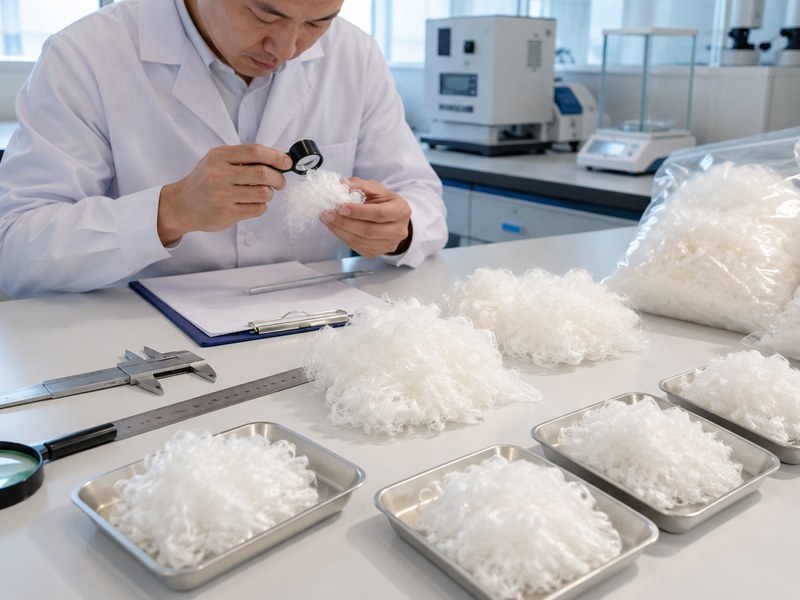
Supplier Evaluation Checklist
Besides testing the sample, buyers should also evaluate the supplier’s quality control ability.
Important questions to ask suppliers:
- Can you provide a Technical Data Sheet?
- Can you provide batch test reports?
- Is the fiber virgin, recycled, or blended?
- What raw materials do you use?
- How do you control denier accuracy?
- How do you control cut length consistency?
- What is your impurity control process?
- Can you provide pre-shipment samples?
- Do you support third-party inspection?
- What is your monthly production capacity?
- Can you keep quality stable for repeat orders?
- Do you have export experience?
- Can you provide reference samples from previous batches?
A trustworthy supplier should respond to these enquiries in an understandable and competent manner. If a supplier avoids technical details, buyers should be cautious.
Common Mistakes Buyers Should Avoid
Many buyers focus only on price and ignore sample testing. This can lead to hidden quality risks.
Common mistakes include:
- Testing only one small sample without checking batch information
- Judging quality only by appearance
- Ignoring denier and cut length accuracy
- Not checking oil content and moisture content
- Forgetting to test the sample on real production equipment
- Not keeping an approved reference sample
- Accepting bulk shipment without pre-shipment inspection
- Comparing suppliers only by price
- Not confirming whether the fiber is virgin or recycled
- Using the wrong PSF grade for the final application
Avoiding these mistakes can help buyers reduce risk and improve procurement efficiency.
Final PSF Sample Testing Checklist
| Testing Step | Key Purpose | Recommended Action |
| Packaging check | Confirm traceability | Check label and batch number |
| Visual inspection | Find obvious defects | Check color, dust, and impurities |
| Denier test | Confirm fiber fineness | Use laboratory testing if needed |
| Cut length test | Confirm processing suitability | Measure random fiber samples |
| Tenacity test | Check strength | Test fiber breaking strength |
| Elongation test | Check flexibility | Confirm stretch performance |
| Crimp test | Evaluate bulkiness | Check wave shape and recovery |
| Moisture test | Avoid storage and weight issues | Use drying method |
| Oil content test | Check processing performance | Test hand feel or lab oil rate |
| Contamination check | Avoid final product defects | Inspect under bright light |
| Production trial | Confirm real performance | Run sample on actual equipment |
| Bulk comparison | Prevent quality mismatch | Compare with approved sample |
Conclusion
Polyester Staple Fiber sample testing helps buyers reduce quality risks and ensure smooth production. Key checks include denier, cut length, strength, elongation, crimp, moisture, oil content, and contamination.
Different applications require different priorities: spinning focuses on fineness and strength, nonwoven on opening and web formation, and filling materials on softness, bulkiness, and resilience.
Buyers should combine lab test data, production trials, approved samples, and batch reports to choose reliable PSF suppliers.