
In sustainable textiles, recycled polyester staple fiber (rPSF) has emerged as a key component. Whether used for yarn, non-wovens, automotive textiles, home furnishings, or technical industrial applications, performance depends heavily on two primary physical attributes: fiber length and denier. Understanding how these characteristics influence final product behavior is essential for material developers, engineers, and textile buyers alike.
Introduction to Fiber Length and Denier
What Is Fiber Length?
Fiber length refers to the physical measurement from one end of a fiber strand to the other. In staple fibers, this is not continuous like filament; instead, fibers are cut into defined lengths—commonly ranging from 12 mm to 76 mm (0.5–3 inches) in recycled polyester.
Why it matters: Fiber length influences how fibers interact during spinning or bonding processes. Longer fibers tend to provide better strength and cohesion; shorter fibers can improve uniformity and reduce hairiness in certain applications.
What Is Denier?
Denier is a unit that expresses the linear density of a fiber—how much one strand weighs relative to its length. Specifically:
Denier = grams per 9,000 meters of fiber
A fiber with a higher denier is thicker; a lower denier is finer.
| Denier Category | Typical Use |
| 1.5–3 dpf | Fine yarns, soft hand |
| 3–6 dpf | Apparel, bedding |
| 6–10 dpf | Upholstery, industrial textiles |
| >10 dpf | Non-wovens, automotive applications |
Both fiber length and denier are drivers of fiber behavior during processing and in finished product performance.
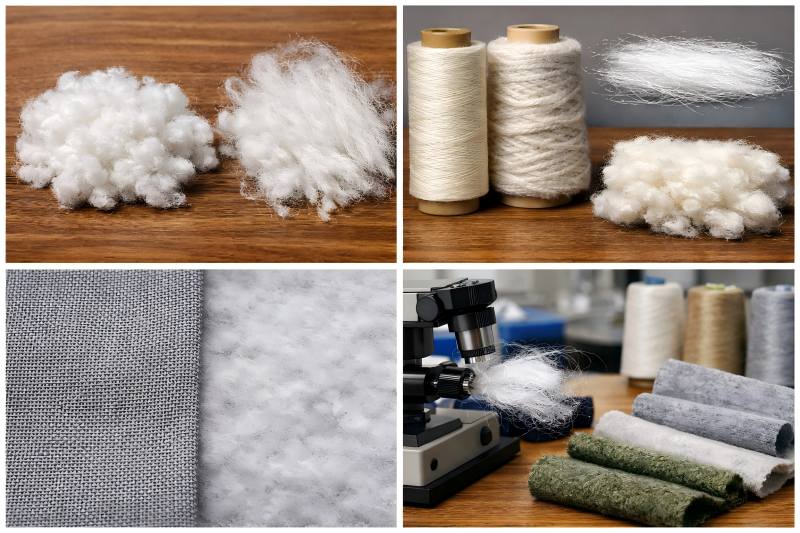
How Fiber Length Affects Performance
Fiber length plays a crucial role in fiber processing, fabric strength, uniformity, and end-use functionality.
Alignment & Cohesion During Spinning
In spinning processes (e.g., ring spinning, open-end spinning), longer fibers can:
- Align more easily
- Interlock better
- Reduce fiber fly and irregular yarn spots
This results in yarns that are:
- Stronger
- More uniform
- Lower in hairiness
Short fibers, on the other hand, tend to:
- Slip more during drafting
- Create weak spots
- Increase yarn imperfections
| Fiber Length | Effect During Spinning |
| Long (e.g., 51–64 mm) | High alignment, strong yarn |
| Medium (e.g., 32–38 mm) | Balanced performance |
| Short (e.g., 12–25 mm) | Lower strength, more variation |
Takeaway: Longer fiber length generally yields better yarn strength and uniformity.
Fabric Strength & Durability
The strength of woven and knitted fabrics is affected by the underlying yarn quality, which is tied to fiber length.
Long fibers provide better inter-fiber friction and cohesion, resulting in:
- Higher tensile strength
- Improved abrasion resistance
- Better dimensional stability
- Short fibers cause weaker yarns and fabrics, which may be suitable for non-woven bonding but less desirable for high-performance textiles.
Surface Smoothness & Handle
Fiber length influences fabric surface quality:
- Longer fibers → smoother fabric surface, less pilling, better drape
- Shorter fibers → rougher surface, higher potential for pilling
- This is particularly relevant in apparel and home textile markets where hand feel and aesthetics matter.
End-Use Examples: Fiber Length
| Application | Recommended Fiber Length | Reason |
| Apparel yarns | 38–64 mm | Strength + soft feel |
| Home textiles | 51–64 mm | Durability + aesthetics |
| Non-woven batting | 12–25 mm | Easy bonding |
| Technical filters | 25–38 mm | Controlled porosity |
How Denier Affects Performance
Denier determines fiber thickness, which directly influences:
- Fabric weight
- Cover factor
- Strength
- Softness
- Processing behavior
- Let’s break this down.
Denier & Fabric Hand Feel
Finer denier fibers (low dpf) deliver softer, more luxurious textures, ideal for:
- Apparel
- Bedding
- High-quality knitwear
Higher denier fibers (high dpf) are:
- Coarser to the touch
- Stronger and more resilient
- Ideal for applications where durability outweighs hand feel
| Fiber Denier | Typical Feel | Application |
| <3 dpf | Soft | Fine apparel, linings |
| 3–6 dpf | Balanced | Casual wear, sheets |
| 6–10 dpf | Moderate | Upholstery |
| >10 dpf | Rugged | Industrial & non-wovens |
Denier & Fabric Strength
Thicker fibers provide more mass per strand, contributing to:
- Increased tensile strength
- Better abrasion resistance
- Greater structural integrity
However, extremely high denier can:
- Compromise softness
- Reduce drape
- This trade-off must be aligned with product goals.
Denier & Dye Uptake
Finer fibers have higher surface area per unit weight, improving:
- Dye uptake
- Color brightness
- Consistent dyeing
Higher denier fibers may require:
- Longer dyeing cycles
- More attention to chemical balance
This becomes especially important in recycled fibers where color consistency is already a challenge.
Denier & Processing Efficiency
Spinning, weaving, and knitting machines perform differently depending on denier:
| Denier Range | Processing Considerations |
| Low (1.5–3 dpf) | Requires precise tension control |
| Mid (3–6 dpf) | Balanced ease of processing |
| High (>6 dpf) | Fewer breaks, easier handling |
Key insight: Mid-range deniers often hit the sweet spot between processing ease and product performance.
Interplay Between Fiber Length & Denier
Fiber length and denier are not independent. Their interaction defines many aspects of textile behavior.
Fiber Ratio Effects
| Fiber Length | Denier | Expected Outcome |
| Long + Low | Smooth, strong, soft | High-end yarns |
| Long + High | Strong but coarse | Heavy fabrics |
| Short + Low | Difficult to spin | Lint, weak yarns |
| Short + High | Easy to process non-woven | Bonded media |
Key principle: Matching fiber length & denier to your intended process and final application is essential.
Yarn & Fabric Properties Matrix
| Fiber Length | Denier | Yarn Strength | Fabric Hand | Process Difficulty |
| Long | Low | High | Soft | High |
| Long | High | Very High | Moderate | Moderate |
| Short | Low | Low | Soft | Very High |
| Short | High | Moderate | Coarse | Low |
This matrix helps buyers assess trade-offs quickly.
Practical Considerations in rPSF Specifications
When specifying recycled polyester staple fiber for mass production, consider:
End-Use Requirements
- Fashion apparel: Low to mid denier + long fiber
- Home textiles: Mid denier + long fiber
- Industrial textiles: Mid to high denier + chosen length
- Non-wovens: Short to mid length + mid to high denier
Sustainability & Traceability
rPSF can be sourced from:
- Post-consumer PET
- Post-industrial PET
Sustainability claims (e.g., GRS, RCS) are only meaningful if backed by consistent quality. Both fiber length and denier need verification against standards.
Cost-related factors
- Because of the intricacy of processing, longer and finer fibers are typically more expensive.
- Bulkier or shorter fibers may be cheaper but yield different performance.
Decision makers should balance performance vs. cost based on product positioning.
Testing & Quality Control
Standard Tests for Fiber Length
Fiber length distribution can be measured using:
- Optical analyzers
- Textile laboratory measurement tools
- Automatic fiber analyzers
Quality is assessed in terms of:
- Mean fiber length
- Standard deviation
- Short fiber content
Denier Testing
Denier is typically measured by:
- Cutting exact fiber lengths
- Weighing measured samples
- Calculating based on standard formulas
Consistent denier ensures:
- Predictable spinning
- Uniform fabric appearance
- Reliable processing
Common Challenges & Solutions
Variability in Recycled Fiber
Recycled fibers often have more variation than virgin polyester due to feedstock differences.
Solution: Tight quality control and better sorting before recycling.
Dyeing Issues in Recycled Fibers
Uneven dye uptake may occur if denier variation is high.
Solution: Control denier consistency and use pre-treatment processes.
Low Strength in Short Fiber Blends
Short fibers can weaken yarns.
Solution: Blend with longer staple fibers or adjust spinning parameters.
Case Studies
Case 1: Apparel Knitwear Manufacturer
Goal: Soft hand, good strength, uniform dyeing
Specification:
- Fiber length: 51–64 mm
- Denier: 3–4 dpf
Outcome: Balanced performance with excellent hand feel.
Case 2: Automotive Carpet Supplier
Goal: High abrasion resistance, dimensional stability
Specification:
- Fiber length: 32–38 mm
- Denier: 8–12 dpf
Outcome: Strong, durable textile with acceptable aesthetics for automotive use.
Decision Framework for rPSF Specification
| Step | Action |
| 1 | Define end product application |
| 2 | Determine key performance metrics (strength, softness, durability) |
| 3 | Choose preliminary fiber length based on the application |
| 4 | Select denier based on strength vs. hand feel |
| 5 | Conduct trial batches with chosen specs |
| 6 | Adjust based on test results |
This framework simplifies specification decisions.
Fiber length and denier are foundational characteristics that profoundly influence the performance of recycled polyester staple fiber. Whether you’re producing high-end apparel, home textiles, or industrial non-wovens, understanding the interplay of these two properties will help you:
- Optimize product performance
- Improve processing efficiency
- Reduce defects and waste
- Align sustainability goals with quality standards
In a market that increasingly demands both sustainability and performance, choosing the right combination of fiber length and denier is not optional—it’s essential.