
As sustainability becomes a core principle for textile brands, fashion houses, and industrial manufacturers, recycled polyester staple fiber (rPSF) has risen in importance. Recycled polyester staple fiber offers environmental advantages—reduced waste, lower energy usage compared to virgin polyester, and reduced greenhouse gas emissions. However, finding the best deal is not the only way to source rPSF. Manufacturers must evaluate suppliers across quality, compliance, traceability, capacity, and long-term reliability.
Why Choosing the Right Supplier Matters
Before diving into criteria, it’s critical to understand why supplier choice matters:
- Product Consistency: rPSF quality affects yarn strength, dye uptake, fabric hand feel, and finished product performance.
- Brand Reputation: Poor sustainability claims or traceability can damage credibility.
- Regulatory Compliance: Many markets require strict standards for recycled content claims.
- Cost & Production Stability: Reliable suppliers reduce delays and inventory risk.
Your rPSF supplier is not just a vendor—they are a strategic partner.
Understand Your Own Requirements First
Before comparing suppliers, clearly define what your company needs:
| Requirement | Questions to Ask Yourself |
| Product Specifications | What denier, cut length, and color range do we need? |
| Recycled Content | Do we require post-consumer recycled (PCR) or post-industrial recycled (PIR) fiber? |
| Certifications | Which certifications must our materials hold (e.g., GRS, RCS)? |
| Volume & Growth | What is our current order volume and expected growth? |
| Lead Time Sensitivity | How long of lead times can we tolerate? |
| Budget Constraints | What is our target COGS for rPSF material? |
A supplier that fits another company perfectly might be a poor match for your needs unless you clarify requirements first.
Key Criteria for Evaluating rPSF Suppliers
Below are the most important criteria when selecting the right rPSF supplier:
A. Quality & Technical Performance
High-quality recycled polyester staple fiber should meet performance expectations such as strength, uniformity, and dyeability.
Key quality indicators include:
- Tensile strength and elongation
- Uniform DEN (Denier)
- Low foreign matter content
- Consistent cut length
- Colorfastness if supplied in co colored form
- Ask suppliers for technical data sheets (TDS) and sample batches before final decisions.
B. Sustainability & Traceability
Not all recycled fibers are equal. Traceability means being able to track material back to its source and verify recycled content.
| Feature | Importance |
| GRS / RCS Certification | Ensures verified recycled content |
| Chain of Custody Documentation | Critical for sustainability claims |
| Third-party Audits | Adds credibility |
| PCR vs PIR Breakdown | Post-consumer is generally more valuable for branding |
Suppliers that cannot demonstrate traceability make it difficult for brands to validate sustainability claims.
C. Production Capacity & Scalability
Assess whether the supplier can:
- Handle your current volume orders
- Scale with your growth
- Adjust quickly for seasonal demand shifts
Also ask:
- Do they stock inventory or produce made-to-order?
- Do they have multiple production lines or plants?
A supplier with limited capacity may meet small orders but fail as your business grows.
D. Consistency Across Batches
Inconsistent fiber properties can disrupt downstream textile processes. Evaluate:
- Quality variance between batches
- Supplier’s internal QC processes
- Percentage of defect rates
Reliable suppliers maintain tight tolerances and quality control systems.
E. Compliance & Certifications
Regulatory compliance and recognized standards are fundamental, especially when marketing sustainable products.
| Standard | What It Means |
| Global Recycled Standard (GRS) | Verifies recycled content and responsible practices |
| Recycled Claim Standard (RCS) | Confirms recycled material content |
| OEKO-TEX | Tests for harmful substances |
| ISO / ASTM | Quality & testing standards |
Working with suppliers holding certified materials simplifies your compliance with customer or legal requirements.
F. Price & Total Cost of Ownership
While price is important, the lowest cost supplier is not always the best choice. Consider:
- Freight and logistics costs
- Inventory carrying costs
- Potential production delays
- Cost of quality issues
A slightly higher unit price with exceptional reliability often yields better total value.
G. Logistics & Delivery Reliability
Evaluate shipping efficiency and delivery performance:
| Logistics Factor | What to Check |
| Lead Time | Standard production + shipping time |
| On-time delivery rate | % of shipments delivered on schedule |
| Customs & Import Support | Assistance with documentation |
| Packaging Standards | Safe handling of fibers |
Unpredictable logistics can create bottlenecks for your production schedule.
H. Supplier Reputation & References
Look beyond the sales pitch:
- Ask for customer references
- Search industry forums and reviews
- Check business history and financial stability
- Visit supplier facilities if possible
A supplier’s reputation often reveals insights that certificates and catalogs cannot.
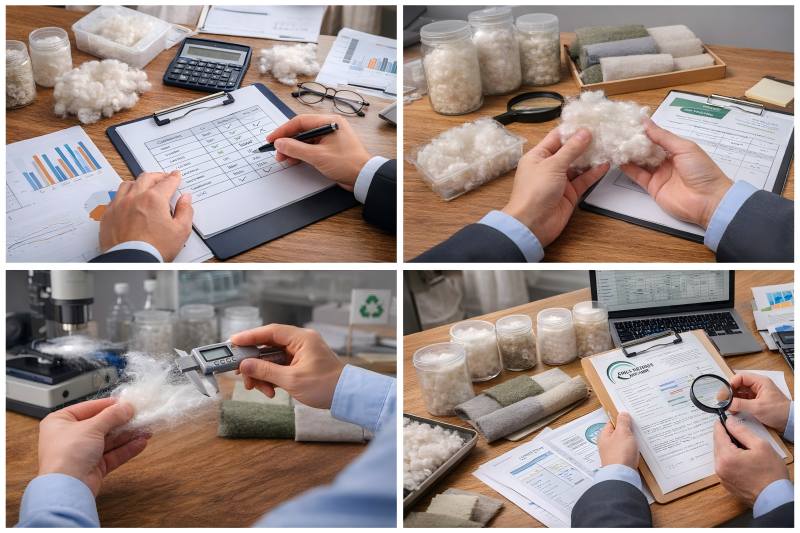
Questions to Ask Potential rPSF Suppliers
During vetting, ask suppliers specific questions such as:
- What recycled content certifications do you hold?
- Can you provide independent lab test reports?
- What are your lead times for new and repeat orders?
- How do you ensure batch consistency?
- Can you supply traceability documentation (PCR/PIR source data)?
- What procedure do you use for quality control?
- Do you provide alternatives for custom denier and length?
- What is your minimum order quantity (MOQ)?
- How do you handle defective batches or claims?
- Can you scale with our projected volume growth?
These direct questions streamline comparison and reduce ambiguity.
Supplier Comparison Framework
Below is a structured table to help you compare multiple suppliers:
| Criteria | Supplier A | Supplier B | Supplier C |
| GRS / RCS Certified | Yes/No | Yes/No | Yes/No |
| PCR Content % | 50% | 30% | 70% |
| Batch Consistency Score | 9/10 | 7/10 | 8/10 |
| Price per Kg | $X | $Y | $Z |
| Lead Time (days) | 30 | 45 | 25 |
| On-time Delivery % | 95% | 88% | 92% |
| MOQ | 500 kg | 1000 kg | 300 kg |
| Tech Support Quality | High | Medium | High |
| Traceability Score | 8/10 | 6/10 | 9/10 |
| Overall Score | — | — | — |
Using a scoring method makes the decision more objective.
Red Flags to Watch
Be cautious of suppliers who:
- Cannot provide certification documentation
- Claim unrealistically low prices
- Refuse to offer technical samples
- Lack clear traceability
- Do not conduct consistent quality testing
Early detection of these signs prevents costly mistakes later.
The Importance of Technical Sampling
Never skip technical sampling. A supplier may appear strong on paper, but only material testing confirms performance. A proper sampling process should include:
- Small batch delivery
- Laboratory testing for strength, uniformity, impurities
- Trial runs in your production environment
- Sampling avoids surprises when full orders arrive.
How Sustainability Goals Influence Supplier Choice
Your company’s sustainability strategy shapes supplier requirements. If your brand markets high levels of recycled content, then:
- Prioritize 100% post-consumer recycled content
- Choose suppliers with traceability verification
- Evaluate carbon footprint disclosures
Suppliers with stronger sustainability credentials often allow you to tell a more compelling story to your customers.
Practical Scenario Examples
Case 1: Small Apparel Manufacturer
- Needs small MOQs
- Prioritizes flexibility in cut length
- Values certifications highly
Best fit: Supplier with lower MOQ, strong sustainability documentation, and high responsiveness.
Case 2: Large Industrial Textile Producer
- Requires volume stability
- Demands strict technical uniformity
- Has long-term contracts
Best fit: Supplier with large capacity, strong QC systems, and proven delivery reliability.
Negotiation Tips
When negotiating with rPSF suppliers:
- Ask for volume discounts
- Negotiate extended payment terms
- Inquire about priority production slots
- Discuss penalties for late deliveries
- Request bundled services (testing, packaging, logistics support)
Negotiation strengthens your partnership and reduces supply risk.
How to Build Long-Term Supplier Relationships
Choosing a supplier is only step one—building a sustainable partnership is key:
- Share your forecasted demand
- Hold quarterly performance reviews
- Offer feedback on quality issues
- Collaborate on process improvements
- Consider co-investment in technology upgrades
- Strong partnerships reduce costs and improve innovation over time.
Choosing the right recycled polyester staple fiber supplier is a long-term decision impacting quality, sustainability, cost, brand reputation, and the credibility of your sustainability commitment.