
Polyester Staple Fiber, or PSF, is widely used in textiles, nonwovens, filling, filtration, furniture, automotive, and hygiene products. China supplies many PSF types, including virgin, recycled, hollow, solid, siliconized, non-siliconized, and flame-retardant fiber.
Importing PSF from China can reduce costs and ensure a stable supply, but buyers should check specifications, suppliers, samples, shipping terms, documents, payment risks, and quality control.
Understand What Type of Polyester Staple Fiber You Need
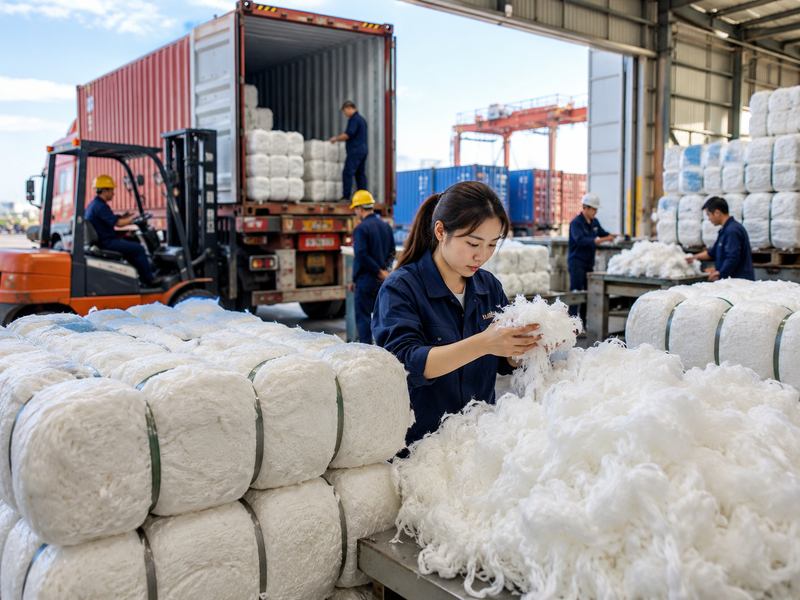
Before contacting suppliers, buyers should clearly define the required PSF specification. Different applications require different fiber types. For example, spinning mills usually need stable fiber length, strength, and fineness, while filling factories may care more about softness, resilience, and bulkiness.
Common Polyester Staple Fiber Types
| PSF Type | Main Features | Common Applications |
| Virgin PSF | Made from new polyester raw material, with stable quality | Spinning, high-grade nonwoven, premium filling |
| Recycled PSF | Made from recycled PET flakes or bottles, cost-effective | Filling, padding, geotextile, general nonwoven |
| Hollow Conjugated PSF | Good bulkiness and elasticity | Pillows, quilts, cushions, toys |
| Siliconized PSF | Smooth hand feel, better softness | Bedding, sofa filling, garment padding |
| Non-Siliconized PSF | Stronger friction, lower cost | Needle-punched nonwoven, industrial use |
| Flame-Retardant PSF | Treated for fire resistance | Furniture, automotive interiors, public-use textiles |
| Low-Melt PSF | Melts at a lower temperature for bonding | Thermal bonding, acoustic panels, mattress materials |
A clear product requirement helps reduce communication errors and prevent wrong shipments.
Confirm Key Technical Specifications
Polyester Staple Fiber is a technical product. Buyers should not only ask for “white fiber” or “fiber for filling.” A professional inquiry should include detailed parameters.
Important PSF Specifications
| Parameter | Common Options | Why It Matters |
| Fineness | 1.2D, 1.4D, 1.5D, 3D, 6D, 7D, 15D | Affects softness, strength, spinning performance, and filling feel |
| Cut Length | 32mm, 38mm, 51mm, 64mm | Must match spinning, nonwoven, or filling equipment |
| Color | Raw white, optical white, black, colored | Affects finished product appearance |
| Grade | Virgin, recycled, semi-dull, bright | Affects quality and price |
| Crimp | 2D, 3D, hollow conjugated | Affects elasticity and bulkiness |
| Siliconized | Yes or no | Affects smoothness and hand feel |
| Moisture | Usually controlled by the supplier’s standard | High moisture may affect weight and processing |
| Packing | Bale packing is usually compressed | Affects container loading and storage |
When requesting a quotation, include your target application. Based on your production process, a reputable provider can suggest the best specification.
Find Reliable Polyester Staple Fiber Suppliers in China
China has many PSF manufacturers and trading companies. Some suppliers have their own production lines, while others source from different mills. Both can be useful, but buyers should verify the supplier carefully.
Common Ways to Find Suppliers
- B2B platforms such as Alibaba, Made-in-China, and Global Sources
- Google search using terms like “Polyester Staple Fiber manufacturer China”
- Textile exhibitions and industry trade shows
- Referrals from freight forwarders or industry contacts
- Direct sourcing from Chinese industrial regions
Supplier Verification Checklist
| Item to Check | Why It Is Important |
| Business license | Confirms legal company identity |
| Factory photos/videos | Helps verify production capability |
| Export experience | Reduces documentation and shipping mistakes |
| Product test reports | Shows technical quality level |
| Customer references | Helps evaluate reliability |
| Production capacity | Ensures a stable bulk supply |
| Quality control process | Reduces batch quality risk |
| Communication speed | Important for long-term cooperation |
Do not rely only on product photos. Many fiber products look similar, but quality may vary greatly in strength, crimp, impurity level, oil content, and consistency.
Request Samples Before Bulk Order
Sample testing is essential before importing Polyester Staple Fiber from China. A sample helps buyers confirm whether the fiber matches their application.
What to Test in a PSF Sample
| Test Item | What to Check |
| Appearance | Color, cleanliness, impurities, fiber uniformity |
| Fineness | Whether the denier matches the specification |
| Length | Whether the fiber cut length is stable |
| Crimp | Elasticity, crimp shape, and recovery |
| Strength | Tensile performance during processing |
| Oil Content | Too much or too little oil may affect machines |
| Moisture | High moisture can increase hidden costs |
| Trial Production | Performance on spinning, filling, or nonwoven equipment |
For large orders, buyers can also use third-party testing companies before shipment. This is especially useful when importing for the first time.
Compare Prices Correctly
The cheapest quotation is not always the best choice. Polyester Staple Fiber prices depend on raw material, recycled or virgin grade, denier, length, color, silicon treatment, production cost, packing, and market conditions.
Factors That Affect PSF Price
| Factor | Price Impact |
| Virgin vs recycled material | Virgin PSF is usually more expensive |
| Fineness | Fine denier fiber often costs more |
| Siliconized treatment | Adds processing cost |
| Hollow conjugated structure | Usually higher than solid fiber |
| Flame-retardant function | Higher cost due to additives |
| Color requirement | Custom colors may increase cost |
| Order quantity | A larger quantity may get a better price |
| Shipping term | FOB, CIF, or DDP changes the total landed cost |
Buyers should compare the total landed cost, not only the factory price. The total cost may include product price, inland transport, ocean freight, insurance, customs duty, import VAT or tax, port charges, customs clearance, warehouse cost, and inland delivery.
Choose the Right Trade Term
International buyers should understand Incoterms before placing an order. The International Chamber of Commerce publishes Incoterms, which are international business guidelines that specify obligations between buyers and sellers in international trade.
Common Trade Terms for PSF Imports
| Trade Term | Meaning | Suitable For |
| EXW | Buyer handles almost all logistics from the supplier factory | Experienced buyers with China logistics support |
| FOB | The supplier delivers goods to the China port and loads them onto the vessel | Most common option for experienced importers |
| CIF | Supplier pays freight and insurance to the destination port | Buyers who want a simpler freight arrangement |
| DDP | Supplier handles delivery, duties, and customs to the buyer’s address | Small or inexperienced buyers, but the risk must be checked carefully |
FOB is often preferred by experienced importers because the buyer can control the freight forwarder, shipping schedule, destination charges, and customs clearance. CIF may look convenient, but buyers should check destination port charges carefully.
Prepare Import Documents
Correct documentation is critical for smooth customs clearance. Required documents vary by country, product, and shipping method. The U.S. International Trade Administration notes that the importer or freight forwarder is often the best starting point for confirming required export documents.
Common Documents for Importing PSF
| Document | Purpose |
| Commercial Invoice | Shows seller, buyer, product, value, quantity, and trade terms |
| Packing List | Shows bale quantity, gross weight, net weight, and packing details |
| Bill of Lading | Shipping document issued by the carrier |
| Certificate of Origin | Shows the country of origin, often needed for customs |
| Sales Contract | Confirms order terms between buyer and supplier |
| Test Report | Supports product quality verification |
| Insurance Policy | Required if insurance is purchased |
| Customs Declaration | Used for export and import clearance |
China export shipments also require customs declaration information, and China Customs provides official guidance related to import and export declaration forms.
Check HS Code, Duty, and Local Regulations
Polyester Staple Fiber normally falls under Chapter 55 of the Harmonized System. For instance, polyester staple fibres that have not been carded, combed, or otherwise prepared for spinning are classified under 5503.20 in the U.S. HTS.
However, buyers should not rely on a supplier’s HS code without checking. HS code classification, import duty, anti-dumping duty, VAT, labeling rules, and customs requirements may vary by destination country.
What Buyers Should Confirm
- Correct HS code in your country
- Import duty rate
- VAT or GST
- Any anti-dumping or additional tariffs
- Required certificate of origin
- Labeling and marking requirements
- Customs broker requirements
- Local textile or chemical regulations
For U.S. buyers, CBP emphasizes that importers and the importing community share responsibility for compliance with customs laws and regulations.
Plan Shipping and Container Loading
Polyester Staple Fiber is usually packed in compressed bales. It is bulky, so container loading efficiency is important.
Shipping Options
| Shipping Method | Advantages | Disadvantages |
| Full Container Load | Lower unit freight cost, safer handling | Requires larger order quantity |
| Less than Container Load | Suitable for trial orders | Higher handling risk and cost per unit |
| Sea Freight | Best for bulk PSF import | Longer transit time |
| Air Freight | Fast | Too expensive for most PSF orders |
Most bulk PSF orders are shipped by sea. Buyers should confirm container loading quantity with the supplier because bale size, compression level, and fiber type affect loading volume.
Quality Control Prior to Shipment
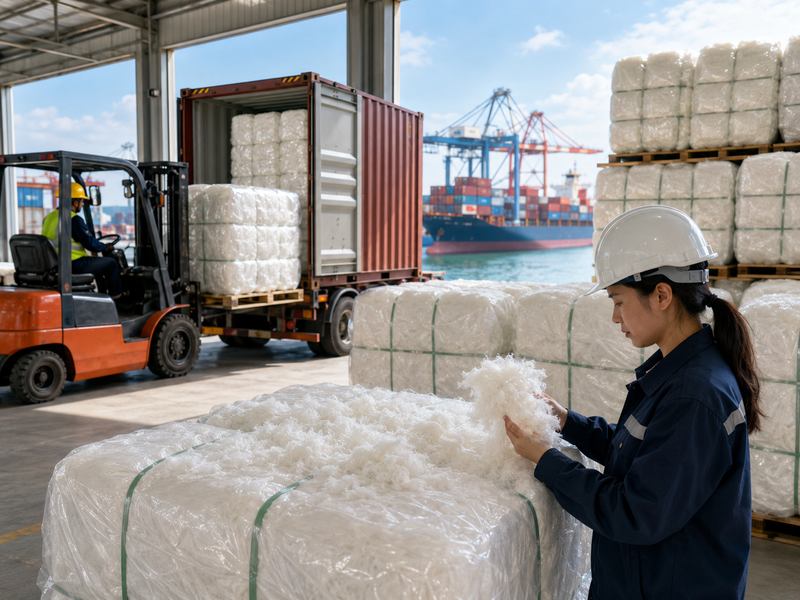
Quality control shouldn’t be postponed till the products are delivered. Once the shipment reaches your warehouse, returning fiber to China is expensive and difficult.
Pre-Shipment Inspection Checklist
- Confirm product type, denier, length, and color
- Check bale packing and labels
- Verify net weight and gross weight
- Inspect fiber cleanliness and impurities
- Compare bulk goods with the approved sample
- Review the test report
- Take loading photos or videos
- Confirm container number and seal number
For first orders, buyers can arrange a third-party inspection. For repeat orders, buyers may still request batch photos, production records, and loading supervision.
Choose Safe Payment Terms
Payment terms are important when importing from China. Until the supplier has been thoroughly vetted, new buyers should refrain from paying 100% before production.
Common Payment Terms
| Payment Term | Risk Level | Notes |
| 30% deposit, 70% before shipment | Common | Suitable after supplier verification |
| Letter of Credit | Lower buyer risk | More bank cost and paperwork |
| 100% before production | High risk | Not recommended for new suppliers |
| 100% after delivery | High seller risk | Rare for international trade |
| Trade assurance platform | Medium | Useful for small trial orders |
For the first order, buyers can start with a smaller quantity, test the product, and then increase order volume gradually.
Common Mistakes to Avoid
Many PSF import issues arise as a result of customers ignoring technical or logistical details in favour of pricing.
Common Importing Mistakes
- Buying without sample testing
- Not confirming the denier and the cut length clearly
- Comparing the FOB price with the CIF price incorrectly
- Ignoring destination port charges
- Using the wrong HS code
- Not checking the supplier’s export experience
- Accepting unclear packing details
- Not arranging pre-shipment inspection
- Paying too much before verification
- Not keeping a signed contract and approved sample
Avoiding these mistakes can reduce disputes, delays, and unexpected costs.
13. Step-by-Step Import Process
| Step | Action |
| 1 | Define PSF type, denier, length, color, and application |
| 2 | Search and shortlist Chinese suppliers |
| 3 | Verify supplier license, factory, and export experience |
| 4 | Request quotation and technical data sheet |
| 5 | Order samples and test them |
| 6 | Confirm price, trade term, lead time, and payment term |
| 7 | Sign the contract and arrange the deposit |
| 8 | Monitor production and quality |
| 9 | Arrange an inspection before shipment |
| 10 | Prepare shipping and customs documents |
| 11 | Complete import customs clearance |
| 12 | Receive goods and test bulk quality |
Conclusion
Importing Polyester Staple Fiber from China can offer competitive pricing, stable supply, and flexible product options. Buyers should confirm PSF specifications, test samples, verify suppliers, understand trade terms, prepare customs documents, check duties, and inspect quality before shipment.
A successful PSF import order should consider total landed cost, supplier reliability, product performance, and long-term supply stability—not just low price.=[]]