
Poor carding performance in polyester staple fiber usually results from unstable feeding, wrong settings, worn card clothing, static electricity, or poor fiber preparation.
To solve it, check fiber quality, control moisture and static, adjust licker-in, cylinder, flat, and doffer settings, clean the carding area, and monitor sliver quality.
Good carding should open fiber tufts, reduce neps and impurities, align fibers, and produce a stable sliver or web.
Common Poor Carding Problems and Solutions
| Problem | Common Signs | Main Causes | Practical Solutions |
| High neps | Small fiber knots in a web or a sliver | Poor opening, worn wires, high feed load | Improve opening, reduce overload, check card clothing |
| Uneven web | Thick and thin patches | Unstable feeding, poor chute feed, air pressure fluctuation | Stabilize feed mat and check chute control |
| High sliver U% | Irregular sliver weight | Poor drafting, cylinder loading, bad doffing | Clean card, adjust draft, inspect doffer |
| Fiber wrapping | Fiber sticks to rollers | Static, wrong finish oil, low humidity | Control humidity, use anti-static finish |
| Excessive waste | Too much usable fiber removed | Aggressive settings, wrong mote knife setting | Reduce waste extraction and rebalance settings |
| Poor fiber parallelization | Weak yarn/nonwoven web | Inadequate carding action | Optimize cylinder-flat setting and speed balance |
What Does Good Carding Performance Mean?
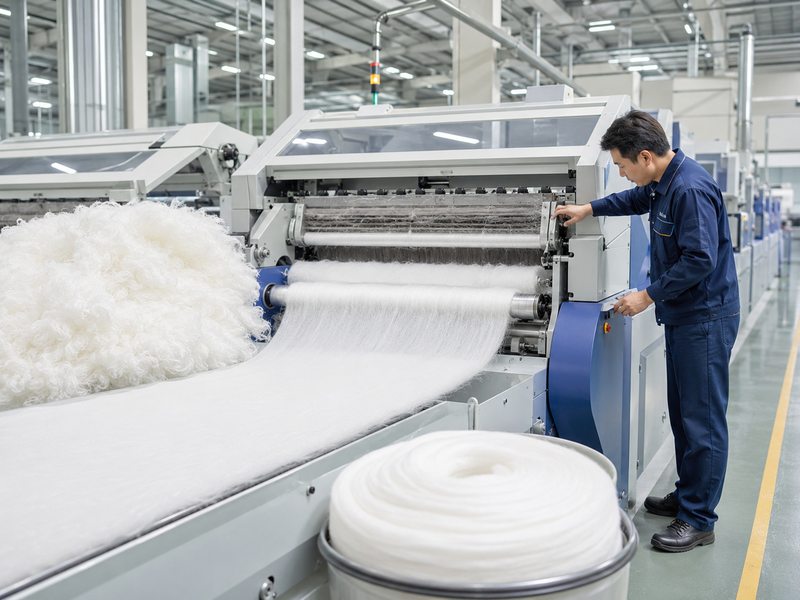
In polyester staple fiber production and downstream spinning or nonwoven processing, carding quality directly affects yarn evenness, fabric appearance, web strength, production stability, and customer complaints.
A good carding process should:
- Open polyester staple fiber tufts into smaller fiber groups.
- Individualize fibers as much as possible.
- Reduce neps, unopened fiber clusters, and foreign particles.
- Align fibers in a more controlled direction.
- Deliver a uniform web or silver.
- Avoid excessive fiber damage or short fiber generation.
In carding, the doffer removes fiber from the main cylinder and helps convert the web into a sliver. The sliver is mainly held together by friction between fibers, so fiber cohesion, finish, and carding condition all influence final sliver stability.
For polyester staple fiber, poor carding often appears more suddenly than cotton because polyester is sensitive to static electricity, finish oil level, fiber crimp, cut length, and friction behavior.
Main Symptoms of Poor Carding Performance
Before solving the problem, you need to identify the exact symptom. Different problems may look similar, but their causes are not always the same.
| Symptom | What It Means | Possible Impact |
| Patchy web | Uneven fiber distribution across machine width | Uneven sliver, web breakage, poor fabric appearance |
| High nep content | Fibers are entangled into knots | Yarn defects, rough fabric surface, dyeing defects |
| Fiber fly | Fibers escape into machine area | Waste increase, cleaning burden, safety risk |
| Roller wrapping | Fibers cling around rollers | Machine stoppage, web breakage, production loss |
| Short-term fiber growth | Fibers are damaged during processing | Lower yarn strength, more pilling, more dust |
| Sliver breaks | Sliver lacks cohesion or consistency | Lower efficiency, unstable downstream production |
| High waste | Good fiber is removed as waste | Higher production cost |
Check Polyester Staple Fiber Quality First
Poor carding is not always caused by the carding machine. Many problems start from the fiber itself.
Important polyester staple fiber parameters include:
| Fiber Factor | Why It Matters in Carding |
| Cut length | Too much length variation causes uneven carding and drafting |
| Denier | Fine denier fibers are more prone to static and wrapping |
| Crimp level | Too little crimp reduces cohesion; too much crimp increases entanglement |
| Finish oil | Affects fiber-metal friction, static, and opening behavior |
| Moisture regain | Very dry fiber can increase static problems |
| Bale opening | Poor opening creates large tufts and nep formation |
For polyester, spin finish is especially important. Rieter notes that fiber-fiber friction, fiber-metal friction, and static generation are strongly influenced by spin finish, and these factors affect processing behavior and yarn quality.
Practical Solutions
Check whether the problem happens with all fiber lots or only one batch. If only one batch performs poorly, test finish oil content, crimp, cut length, and fiber opening condition. Improve bale conditioning before carding. Avoid feeding hard, compacted, or poorly opened fiber directly into the card. For fine denier polyester staple fiber, use stronger anti-static control and gentler opening.
Improve Fiber Opening Before Carding
If polyester staple fiber enters the card as large tufts, the carding machine must work harder. This increases neps, fiber damage, cylinder loading, and uneven web formation.
Good opening before carding allows the card to individualize fibers more efficiently. Poor opening creates heavy carding load and unstable fiber transfer between licker-in, cylinder, flats, and doffer.
Solutions for Poor Opening
Use a proper bale opener and blending system before carding. Keep feed density stable. Avoid sudden changes in feed volume. Make sure the opener does not over-beat the fiber, because excessive mechanical action can create short fibers and entanglement. For recycled polyester staple fiber, stronger pre-opening and impurity removal may be needed before carding.
Optimize Licker-In and Cylinder Settings
The licker-in opens the feed mat and transfers fiber to the cylinder. If the licker-in speed or setting is wrong, carding performance drops quickly.
Research on carding speed parameters shows that licker-in speed and flat speed can influence sliver unevenness, yarn unevenness, short fiber content, thick places, thin places, and neps.
Common Licker-In Problems
| Problem | Possible Cause | Solution |
| Too many neps | Licker-in action too aggressive or feed mat too thick | Reduce feed load and check speed setting |
| High short fiber | Excessive opening force | Lower aggressive setting and inspect wire condition |
| Poor transfer to cylinder | Incorrect licker-in-cylinder setting | Adjust according to machine manual |
| Fiber accumulation | Worn or dirty licker-in clothing | Clean or replace card clothing |
The licker-in should open the fiber without excessive damage. For polyester staple fiber, the setting must balance opening efficiency and fiber protection.
Check Card Clothing Condition
Worn, damaged, or loaded card clothing is one of the most common reasons for poor carding. Polyester fibers can create friction and deposits on wire surfaces, especially when finish oil is unstable or cleaning is insufficient.
Poor card clothing may cause:
- High neps
- Cylinder loading
- Uneven web
- Poor fiber transfer
- More fly waste
- Reduced carding efficiency
Maintenance Actions
Inspect cylinder wire, flat tops, licker-in wire, and doffer wire. Look for bent wire points, dull teeth, fiber loading, oil deposits, rust, or uneven wear. Clean the carding area regularly. Replace damaged clothing before it creates large-scale quality problems. Do not only adjust machine settings when the real problem is mechanical wear.
Control Static Electricity
Static electricity is a major issue in polyester staple fiber carding. Polyester is a synthetic fiber, and dry conditions can make fibers cling to machine parts, repel each other, wrap around rollers, and create fly.
Static generation can cause fibers to stick to rollers or metal surfaces. It is affected by humidity, processing speed, fiber regain, and additives. Research on textile static also shows that lower humidity and higher speed can increase static charge generation.
Static-Related Problems and Solutions
| Static Problem | Production Sign | Solution |
| Fiber wrapping | Fiber sticks to rollers | Increase humidity and check anti-static finish |
| Web separation | Web becomes unstable | Reduce static and improve fiber cohesion |
| Excessive fly | Fiber floats around machine | Improve room humidity and air control |
| Doffer stripping issue | Web does not transfer smoothly | Clean doffer and reduce electrostatic charge |
| Sliver instability | Sliver breaks easily | Improve finish oil and environmental control |
Many textile processing plants control relative humidity to reduce static. Around 50% RH is often used as a practical humidity level to reduce static build-up in textile processing areas.
Stabilize Feed and Chute System
Even a well-maintained card cannot produce uniform output if the feed is unstable. Polyester staple fiber feed must be consistent in density, width, and flow.
Poor feed causes thick and thin places in the web. It also creates load changes on the licker-in and cylinder. As a result, the carding action becomes unstable.
How to Improve Feeding
Check the chute feed pressure. Make sure the feed mat is even across the full width. Avoid sudden fiber surges. Inspect the feed roller, feed plate, and air control system. Clean blockages in the ducting or chute. For blended polyester fibers, ensure proper mixing before feeding, because uneven blend ratio can also create web variation.
Adjust Cylinder-Flat Settings
The cylinder and flats perform the main carding action. If the setting is too wide, carding becomes weak and neps remain. If the setting is too close, fiber damage and waste may increase.
Flat speed also matters. Research on flat speed found that increasing flat speed can reduce neps because more flats contact the fiber treatment zone and are cleaned more frequently by the brush roller.
Adjustment Guide
| Condition | Possible Setting Issue | Correction Direction |
| High neps remain | Carding action too weak | Check cylinder-flat setting and flat condition |
| High short fiber | Carding too aggressive | Avoid overly close setting or excessive speed |
| High waste | Flats removing too much fiber | Review flat speed and waste setting |
| Cylinder loading | Poor cleaning or wire wear | Clean cylinder and check clothing |
Always adjust gradually. One large adjustment can create a new problem. Record the machine setting, production speed, fiber batch, temperature, humidity, waste percentage, nep count, and sliver U% after every change.
Improve Doffing and Sliver Formation
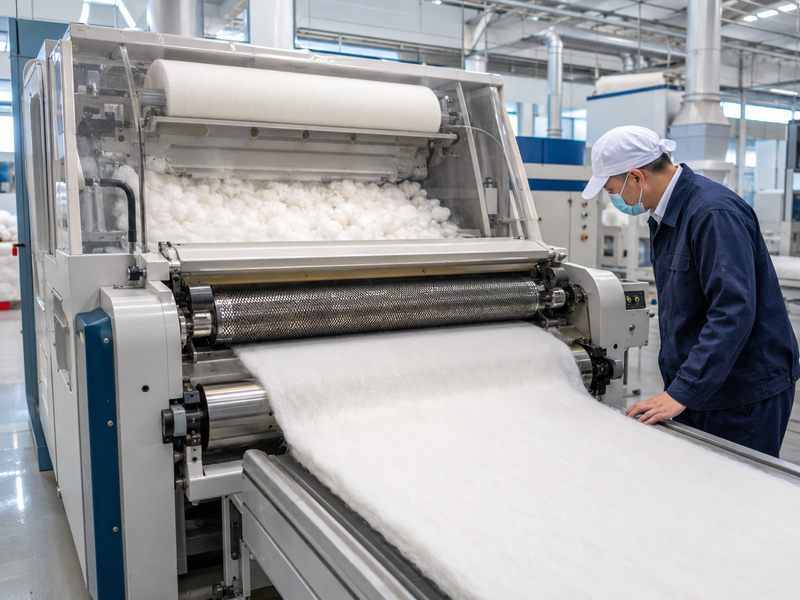
The doffer removes the carded web from the cylinder. Poor doffing creates web breaks, patchy web, roller wrapping, and sliver instability.
Common doffing problems include worn doffer clothing, poor cylinder-doffer setting, static, dirty surfaces, and incorrect web tension. For polyester staple fiber, doffer issues often become worse when humidity is low or finish oil is not suitable.
Solutions
Clean the doffer surface. Check the doffer wire condition. Confirm the cylinder-doffer setting. Make sure the web is transferred smoothly and evenly. Inspect the trumpet and coiler. A blocked trumpet or poorly adjusted coiler can make good carded web look like poor sliver quality.
Reduce Excessive Waste Without Losing Quality
High waste is not always good carding. In polyester staple fiber processing, excessive waste may mean usable fiber is being removed because the carding action is too aggressive or the waste setting is wrong.
You should monitor both quality and yield. If nep reduction improves but waste rises sharply, the process may not be economical.
| Control Item | Target |
| Waste percentage | Keep stable and justified by quality improvement |
| Nep level | Reduce without excessive fiber loss |
| Sliver U% | Improve consistency |
| Short fiber increase | Stay as low as you can. |
| Production speed | Balance output and carding quality |
Build a Carding Troubleshooting Checklist
A structured checklist helps operators solve poor carding performance faster.
| Step | Check Item | Action |
| 1 | Fiber batch | Compare different lots and test finish/crimp/cut length |
| 2 | Room condition | Check humidity, temperature, and static level |
| 3 | Feed system | Inspect chute, feed mat, feed roller, and air pressure |
| 4 | Licker-in | Check speed, setting, cleanliness, and wire condition |
| 5 | Cylinder/flats | Inspect wire, setting, loading, and cleaning |
| 6 | Doffer | Check transfer, wire condition, and doffing stability |
| 7 | Waste | Measure waste rate and usable fiber loss |
| 8 | Sliver quality | Test U%, nep count, weight variation, and breaks |
| 9 | Downstream result | Check yarn, nonwoven web, or final fabric defects |
| 10 | Records | Keep setting and quality data for each fiber lot |
Poor carding performance in polyester staple fiber is usually caused by fiber quality, unstable feeding, worn card clothing, static electricity, wrong settings, or poor maintenance.
To solve it, check fiber condition, feeding, static control, carding zones, doffing, and waste level. Pay special attention to spin finish, humidity, and fiber friction.
Stable carding should produce a uniform web, low neps, smooth doffing, and consistent sliver quality.