
Polyester staple fiber (PSF) serves a wide range of end uses, from textiles and nonwovens to home furnishings, automotive interiors, and industrial products. Its performance relies on tight control of fiber quality during manufacturing.
Although PSF production involves simple steps—spinning, drawing, crimping, and cutting—final performance varies greatly with parameters like denier, tenacity, elongation, shrinkage, crimp, and finish.
This article outlines the key PSF quality parameters, how they are measured, and why they matter for downstream processing and product performance.
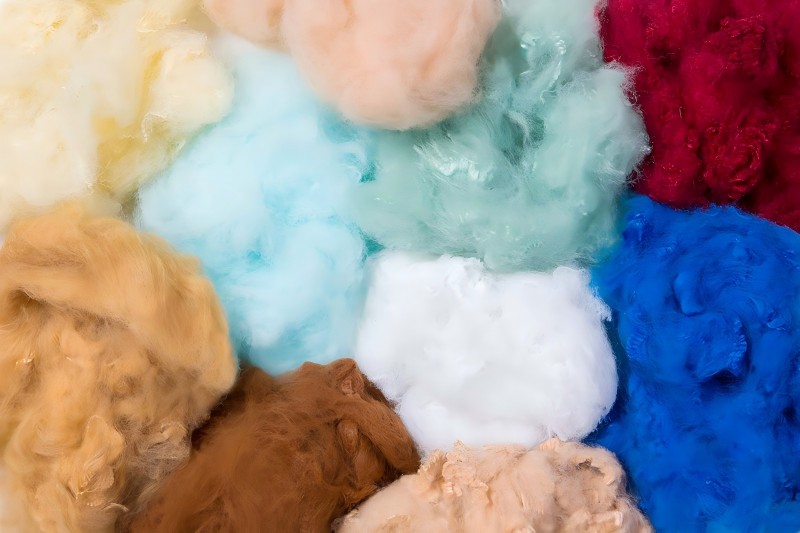
Understanding Polyester Staple Fiber (PSF)
Polyester Staple Fiber is produced by cutting drawn polyester filament into fixed lengths (commonly 25–120 mm). These fibers imitate natural fibers like cotton or wool and are used in both spinning and nonwoven applications.
PSF can be categorized as:
- Virgin PSF – made from pure PTA/MEG polymer
- Recycled PSF (R-PSF) – made from PET bottle flakes
- Solid / Hollow PSF
- Siliconized / Non-siliconized PSF
- Conjugate fiber for thermal bonding
Regardless of type, the fiber’s usability depends on its quality parameters, which must remain stable across batches.
Denier: Fiber Thickness and Weight
Denier is one of the most fundamental quality parameters in PSF manufacturing. It measures the linear mass density of fiber.
What It Means
Denier (D) = grams per 9,000 meters of fiber.
Lower denier = finer fiber
Higher denier = thicker fiber
Typical Denier Ranges for PSF
| Application | Common Denier |
| Spinning yarn | 1.0D – 3.0D |
| Home textile filling | 6D – 15D |
| Stuffed toys | 3D – 7D |
| Nonwoven geotextile | 6D – 15D |
| Automotive interiors | 1.5D – 6D |
| Thermal bonding fiber | 2D – 6D |
Why Denier Matters
- Determines the softness and feel of the fiber
- Affects tensile strength and stiffness
- Influences the fabric drape and surface appearance
- Impacts the loft and resilience in filling applications
An incorrect denier can cause carding issues, uneven yarn, or weak nonwoven bonding.
Tenacity: Fiber Strength
Tenacity is the measure of fiber strength per unit linear density.
Measurement
Tenacity (cN/dtex or g/denier) = breaking force/fiber thickness.
Typical PSF tenacity:
- Standard PSF: 3.5–6.0 g/den
- High-tenacity PSF: 6.0–8.0 g/den
Why Tenacity Is Important
Tenacity influences:
- Yarn strength in ring and OE spinning
- Durability of nonwoven geotextiles
- Tear strength in automotive fabrics
- Fiber resistance to mechanical stress
Low tenacity results in excessive fiber breakage, lint formation, or poor carding performance.
Elongation: How Much the Fiber Can Stretch
Elongation denotes the percentage length increase a fiber can endure before failure.
Typical Elongation Values
- Standard PSF: 20% – 60%
- High-elongation fibers: up to 100%
Why It Matters
Correct elongation ensures:
- Stable performance during spinning
- Smooth fiber drafting
- Resistance to tearing
- Better nonwoven bonding
- Enhanced fabric resilience
If elongation is too high, the yarn may feel weak or uneven. If too low, fibers may break during spinning.
Shrinkage: Thermal Stability of PSF
Shrinkage measures how much the fiber contracts when exposed to heat, typically at 100–180°C.
Typical Shrinkage Values
- Low-shrinkage PSF: < 3%
- Medium shrinkage: 3–6%
- High shrinkage: > 6%
Why Shrinkage Matters
Different applications require different shrinkage levels:
Spinning
Too much shrinkage may cause yarn to twist or deform during dyeing.
Nonwoven processing
Shrinkage influences:
- Fiber bonding
- Dimensional stability
- Heat-setting performance
Filling applications
- High shrinkage fibers may clump after exposure to heat.
- Stability in shrinkage is crucial for consistent performance.
Crimp: Curliness and Cohesion of Fibers
Crimp refers to the waves or curls added to fibers to improve cohesion and bulk.
Crimp parameters include:
- Crimp number (crimps per inch/cm)
- Crimp stability
- Crimp amplitude
Why Crimp Is Important
Crimp affects:
- Spinning cohesion
- Loft and fluffiness
- Resilience in pillows and cushions
- Fabric elasticity
- Nonwoven web formation
Low crimp → poor cohesion and inconsistent web
High crimp → bulky, resilient fiber
Typical Crimp Values
| Application | Crimp Level |
| Spinning PSF | 8–12 crimps/inch |
| Nonwoven PSF | 6–10 crimps/inch |
| Filling fiber | 10–16 crimps/inch |
Cut Length: Fiber Handling and Spinning Behavior
Cut length determines how long each fiber staple is.
Common Cut Lengths
- Spinning: 32 mm, 38 mm, 44 mm, 51 mm
- Nonwoven: 51–64 mm
- Filling: 64–120 mm
Why Cut Length Matters
Correct fiber length ensures:
- Stable drafting in spinning
- Good fiber–fiber friction
- Efficient carding
- Consistent nonwoven web formation
Too short → excessive fly, poor yarn strength
Too long → drafting difficulty, fiber entangling
Fiber Finish: Surface Lubrication and Static Control
Fiber finish is a thin layer of chemicals applied during manufacturing to:
- Reduce friction
- Control static electricity
- Improve spinnability
- Enhance cohesion and blending
Types of PSF Finishes
- Spin finish for spinning PSF
- Nonwoven finish
- Siliconized finish for filling fibers
- Hydrophilic or hydrophobic finish
- Antibacterial or fire-retardant finish
Why It Matters
Finish quality affects:
- Carding speed
- Yarn quality
- Nonwoven bonding
- Fiber softness
- Moisture behavior
A poor finish leads to dust, fly, static, carding breaks, and uneven yarn.
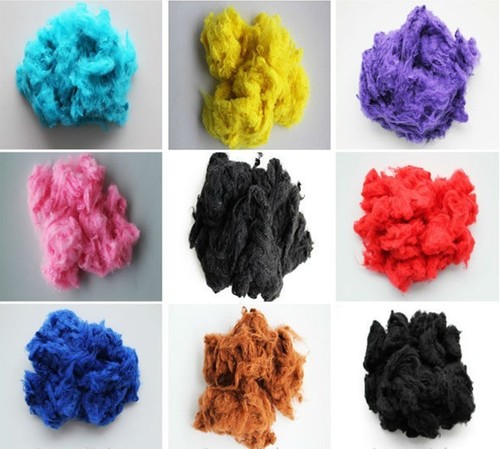
Color & Brightness: Optical Characteristics
PSF color is controlled by delustering agents and optical brighteners.
Types
- Semi-dull (SD)
- Bright (BR)
- Super bright
- Dope-dyed black or colored PSF
Why It Matters
Optical properties affect:
- Fabric appearance
- Dyeing uniformity
- Lightfastness
- UV stability
Colored PSF eliminates dyeing altogether and is widely used in furniture and automotive textiles.
Bulkiness & Resilience: Especially Important for Filling Fibers
For fiberfill products:
- Siliconization
- Crimp type
- Hollow or solid structuredetermine how fluffy and resilient the fiber feels.
Key Parameters
- Hollow ratio
- Siliconized coating level
- Compression recovery
Why It Matters
Bulkiness affects the comfort and longevity of:
- Pillows
- Cushions
- Comforters
- Plush toys
Poor bulk can make products feel flat or stiff.
Moisture Content: Processing Stability
Moisture content must be controlled to avoid:
- Static build-up
- Processing disruptions
- Over-drying or brittleness
- Typical PSF moisture content: ≤ 0.5%
Oil Pick-Up (OPU): Essential for Carding and Spinning
Oil Pick-Up percentage indicates how much finish is applied to the fiber.
- Spinning: 0.3% – 0.7%
- Nonwoven: 0.1% – 0.3%
- Siliconized fiber: special hydrophobic coatings
Quality Parameters Table
Key Quality Parameters in PSF Manufacturing
| Parameter | Typical Range | Why It Matters |
| Denier | 1D–15D | Determines fiber thickness, softness, loft |
| Tenacity | 3.5–8.0 g/den | Affects strength, durability, carding |
| Elongation | 20–60% | Influences stretch and drafting stability |
| Shrinkage | 1–6% | Determines thermal behavior and dimensional stability |
| Crimp | 6–16 crimps/inch | Controls cohesion, bulk, resilience |
| Cut Length | 25–120 mm | Impacts spinning performance and carding |
| Finish | 0.1–0.7% OPU | Controls friction, static, fiber-fiber cohesion |
| Color/Brightness | SD / Bright / Dope-dyed | Affects appearance and dyeing |
| Bulkiness | Depends on hollow ratio & siliconization | Critical for filling performance |
How Manufacturers Ensure PSF Quality Stability
High-quality PSF manufacturing requires:
- Accurate spinning controls
- Laser-guided denier monitoring
- Automated drawing and crimping systems
- Uniform finish application
- Strict quality testing (tensile test, shrinkage test, crimp test)
- Continuous quality inspection per batch
Stable quality reduces customer claims and ensures predictable downstream performance.
PSF production involves more than melting and cutting polyester. Key parameters—denier, tenacity, elongation, shrinkage, crimp, finish, and cut length—define how the fiber performs in spinning, nonwovens, and filling applications.
For manufacturers, tight control ensures consistent, high-performance fiber. For buyers and engineers, understanding these parameters supports better material selection for softness, strength, durability, cost, and processing efficiency.